Every month Lorraine Edmond will give us a closer look at an SDA member, their studio and practice. This monthly post is a great opportunity to get to know our fellow SDA members a little better and to be inspired by our community.
Describe your current medium and how you came to it.
I describe myself as a sculptor working in soft materials. I dye fabric and use it as the skins for the  sculptures and finish everything with stitch. How I came to it? I always thought in 3D—I would rather make Barbie’s house than play with Barbie! But even then, I was frustrated with the materials I had available—taping pieces of typing paper together, for example. At the same time I was always attracted to the community aspect of performance. I went to a performing arts magnet school in Portland, Jefferson HS for the Performing Arts, for my junior and senior year. When I decided I should get a “career” in my twenties, I went to school to study graphic design.
Near the end of my time there, I was working intently on my graduation portfolio, but had some free time and I ended up getting involved in the first Fremont Solstice Parade. It was just a week before the event, and I ended up spending every available hour working on it. There was such a contrast between the meticulous work I’d been doing on my portfolio and these creations made to be seen from more than 10 feet away and used only once. They were scrappy, put together with no budget, they were 3D and they were larger than life. I became very involved with the Parade, ended up being on the Board of the Fremont Arts Council for several years. (I even met my husband there and my kids have been in it every year of their lives.) After my first daughter was born, I went back to design, but found my heart really wasn’t in it. I knew I wanted to be an artist, but I also wanted to be involved in performance.
I wanted to make things to a higher artistic standard, including more focus on craftsmanship—and things that would be used or seen for more than one day. One year the arts council brought in a visiting artist who dyed silk. (Her name was Ali Pretty of Kinetika Design in London–they did work for the Olympics and many other projects.)
I took her workshop and it changed my life. My first project ended up being a 20 foot—6-person dragon puppet! It was huge, but I made it in modules so it could be broken down and stored and it ended up having multiple uses. I learned how to make giant puppets, inflatables, all sorts of things. I fell in love with the fabric and with surface design.
About this time, I found Jane Dunnewold’s Complex Cloth book, and that was another life changing experience. I loved creating fabric, but wondered what I would do with it. I decided to try art quilting and took two classes, one in piecing and one in machine quilting. Other than that, I’m self-taught for the most part. I also took a workshop with Marita Dingus, who has been another big influence. Her work creates both dimension and volume—and helped me find my way back to 3D, which had felt like a missing element when I was making art quilts.
What is your creative process like? (How do you begin? Do you draw to work out your ideas? Do you have a vision before you start or does it develop as you work?)
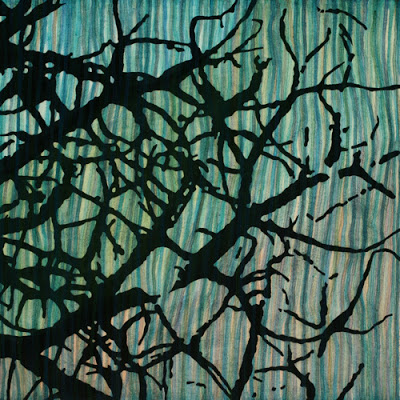
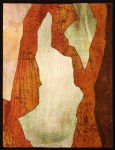
I take a lot of photographs. My upcoming show is based on madrone trees and was inspired by a trip to Orcas Island I took last  spring. I was with my daughter on her 8th grade camp trip and I decided the madrones would be the focus of my next show. Later, I did a solo 3-day retreat there. I’d never done that before. It was lonely at times, but I did a lot of hiking and sketching and took lots of photographs to use as source material. I knew the finished sizes I wanted to work with, so I began drawing the pieces up. Then I went back and picked the best compositions from my sketches and blew them up with an overhead projector to full size. Everything was still 2D at this point. I winnowed that group down and worked the best ones into 3D.
At that point I still had 18 candidates and began the process of designing the paper patterns, but 3 more were eliminated and I ended up with 15. It’s a very labor-intensive process! Then there’s the dyeing. I can usually pull some fabrics from my stash, but I always have to dye more. I needed big pieces for this project, so I had to dye a lot of it. Next I match up the candidate fabrics with the shapes I need. Then I “just” make the piece!
What is your current workspace like?
I work in an old house that has 4 studios. I have about 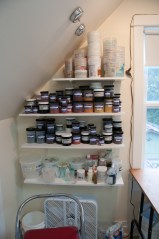 250 square feet on the top floor, minus the space taken up by the large stairwell (but I do have a lot of storage under the eaves).
I have been here 11 years, and the other artists have been here between 7 and 14 years— it’s a wonderful community of artists. I have large skylights and a mountain view and it’s only a mile from my house. This is basically my wet studio and I do the stitching in a room at home. The only drawback to the space is the slanted walls, which make it hard to put work up and look at it from a distance.
If this isn’t your first studio– tell us about some the other workspaces you’ve had– what worked and what didn’t. How does your physical space influence your work?
This is my first and only real studio. I did work at home a little bit early on, but my kids were little and it didn’t seem safe to work with all the dyes and other chemicals at home then. I worked for years in the public workshop setting for the Fremont Solstice Parade.
In that setting, people just pick up your stuff, move things around, use up materials you plan to use. Some find that chaos stimulating, but not me. I keep my studio “clean.” There isn’t a lot of visual stimulation around—just the current work. I like to start fresh with each body of work. Clutter is distracting for me. I like white walls and bare surfaces. I like being able to control my space. I have evolved ways to work here. Everything is modular. I can use my two 6-foot tables in different configurations, together or apart, or can fold them up, depending on whether I need a long print table or floor space. My dye washer is at home, though, so I am constantly carrying wet dyed fabrics home to wash. I do like having a separate sewing studio, and I like working at home sometimes. There, my sewing machine is in a corner with two windows, and looks out over our cherry tree. It’s a bright corner and I have room to move around there.
Do you have a favorite piece of equipment or technique for keeping your studio organized?
Plastic bins work for me—I have a lot of them! I use larger ones for fabric sorting and I have small shoebox sized ones for each type of tool I use. One for just sharpies, one for brayers, one for stamps. They’re all labeled, so I can just toss a tool in the right box and I’ll still be able to find what I need later. They all stack—it’s important to have multiples of the same kind. The other thing is my modular tables. I use them together, apart, or fold them up if I need floor space. I use a piece of laminate on top of them to make a larger surface without a seam in it.
Do you have particular habits that you think support your art practice?
I always have a camera with me. Almost always a point and shoot in my purse, but sometimes just my phone. My work is nature and environment based, so it keeps me checking in with what’s happening. I use the photographs as inspiration for my work and also as documentation for my blog.
What is the best art tip you’ve ever received (or discovered)?
They call it art WORK for a reason. You have to work every day. Inspiration may strike, but you’ve got to be there for that to happen. There’s an Elizabeth Gilbert TED talk on creativity I’ve watched several times You have to be there every day and keep working. Some of what you make will be crap, but you don’t get to skip that part. The other thing: Be kind to yourself! Here’s the link:
(http://www.ted.com/talks/elizabeth_gilbert_on_genius.html)
What inspires you to work and how do you keep motivated when things get tough in the studio?
One word: Deadlines! As a graphic artist, I always had them, events always have them. I’ll apply for a show, know that the images are due by X date, then work the calendar backwards to figure out where I need to be by when. I have a matrix for my upcoming show that shows me just where I am on each piece. I think even people just starting out should apply for shows—it’s a way to be accountable. I keep a lot of records—I take more notes and do more documentation the longer I do this work. Now I have dye books that record about 10 years of experiments. I keep the resulting swatches in plastic protectors in binders, so I can take out individual pages to work with them. When I get a new mixed color, I do all sorts of test with it—different fabrics, different discharge agents. I had some interns recently who helped a lot with organizing those. I also keep a studio journal for individual pieces—the final sizes, the threads and fabric I used It ends up being a page or two per piece, plus a record of what I did, and what I plan to do next. I’ve been doing that for about three years now, and I’d never go back to not doing that.
You can see more of Cameron’s work on her website :cameronannemason.com and keep up with her on her blog here : http://www.cameronannemason.com/blog/
Cameron’s next show at Foster White opens March 7 and will be up through March 30.
http://www.fosterwhite.com/dynamic/artist.asp?ArtistID=36050







 Surface Design Association–Washington
You must be logged in to post a comment.