SDA-WA Saturday Meeting – April 20th

Greetings, All!

Spring has sprung and we are meeting at the Green LAKE branch on Saturday, April 20th at 11:00 a.m.

The sketchbook challenge theme for this month is Opposites–bring your sketchbook and supplies to join us for sketchbook exploration on the theme and for fellowship!

All are welcome; no need to RSVP. Just show up!

See you soon,

Karla Freiheit
206-619-8142

SDA Member Spotlight – In the Studio with Patti Shaw

Studio Spotlight in a new feature for the SDA – WA blog.
Every month Lorraine Edmond will give us a closer look at an SDA member, their studio and practice.  This monthly post is a great opportunity to get to know our fellow SDA members a little better and to be inspired by our community. 

In the Studio with Patti Shaw

Interview by Lorraine Edmond

Patti’s Ballard studio was on the Studio Tour held as part of the SDA-WA Surface Matters symposium last March, so many of you had an opportunity to see it then. But whether or not you’ve had a chance to visit Patti’s studio in person, you are invited in now as we feed our curiosity to look behind the scenes and see how this accomplished SDA member approaches her studio practice.

1. Describe your current medium and how you came to it.
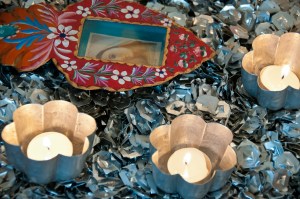
My current work could be described as mixed media.  I’m primarily working with the aluminum tabs left behind after votive candles are burned.  I’m also making some embroidered pieces and drawing on fabric. I’ve made 75 quilts in the past but haven’t made a quilt in over a year.

How did I come to this work?  I had a show at St. James in the chapel—I was showing some of the icon quilts I had been making. When I was there, taking down the show, a worker was changing out the votives, popping the aluminum bases out and putting them in the trash. It was one of those “lightbulb moments” —I thought “those mean something, those stand for someone’s prayer” and I asked him to save them for me.  Now, two or three times a year, I pick up a large box from the church.

For quite a while, I didn’t know what to do with them, so I just stuck them away. Then I saw a call for entry for a show of art made from recycled materials, and I remembered them.  I glued them on to a stretched canvas for that piece, but I later began to sew them together. First, I have to drill holes in them, then I stitch them together to create a metal “fabric.” I realize that connects this work back to my quilts, many of which were based on a grid, were tied, and had loose threads as a source of texture.

2. What is your creative process like? (How do you begin? Do you draw to work out your ideas? Do you have a vision before you start or does it develop as you work?)
I don’t plan ahead.  I use the last piece to move forward.  I like to take things that seem to be unrelated and find a way to associate them to reveal something new. I like to find objects and look for relationships among them.

3. What is your current workspace like?
I work in our previous home, across the alley from where we live now.  I use the living room, dining room, an upstairs bedroom, and an adjacent storage area.  (We are currently getting set up to rent out the rest of the house to visitors through the Air Bnb* program.)

4. If this isn’t your first studio– tell us about some the other work spaces you’ve had– what worked and what didn’t.
When we were living in the house, my studio was the small bedroom upstairs. It didn’t even have a closet, though it is adjacent to an attic storage area. I set up a couple of card tables and pushed them together to create a work surface. One of those was actually the same table I used as a child for my “crafty” activities!  (The second one was one my husband and I found in an alley and it was identical to the first one!)

It was a small space to work in, but had some advantages, especially when my son was young. Fiber work with a small child nearby is relatively quiet and safe – no chemicals like resins, oil paints, mineral spirits, etc.  Plus, it is easy to stop and pick up where you left off – a perfect medium for those brief moments of time you have available when taking care of a young one. Even in that small space, though, I had to be very organized, because I don’t work well with visual clutter surrounding me.

5. Do you have a favorite piece of equipment or technique for keeping your studio organized?
It’s not for staying organized, but my favorite equipment in my studio is my old Singer sewing machine. My mother bought it for me when I was about 13 after I learned to sew on an old treadle—I guess she thought I must really want to sew!  It just goes forward and backward, but it does everything I need.  I can even maintain it myself!

I do like to stay organized, though. I find a place for things and I put them back at the end of the day or when I’m done with them.  When I arrive in the morning, I know where to find things.

6. Does your physical space influence your work in any way? If so, how?
Taking over a larger space really freed me up—I thought “I can make things really big now!” I did start making larger work.  I also started making little installations around the house, just for myself.  It has allowed me to play more and has inspired me to make things.

Bigger space means bigger work. Lots of light means a better mood. Less clutter means more focus.

7. Do you have particular habits that you think support your art practice?
I go to my studio every day, even on weekends.  Not eight hours, but it’s the first thing I do after getting ready for the day.  On the weekends, it may only be for an hour or two, but I make a point to do something.  There’s always something to do!

I don’t take my laptop to my studio—it’s too easy to get sucked in—even looking up a word can take you off somewhere you hadn’t planned to go.  I come home at lunch and check email then. I do listen to music in the studio.

I’ve also had three interns in the past year (one quarter each.) That’s been interesting.  They come for 2-3 hours a couple of days a week, so for that time, I have someone to talk to, but there’s still enough solitude during the week. I find it has forced me to think ahead to make sure I have enough to keep them busy!

8. What is the best art tip you’ve ever received (or discovered)?
I think about what I’m working on the night before, so that when I get to the studio in the morning, I already know what I’m going to do.

9. What inspires you to work and how do you keep motivated when things get tough in the studio?
I do have times when I feel lost and am not sure what to do next.  This often happens after I finish a project or a body of work or prepare a big show—I feel like I’m fumbling around for a while.  It helps to have other artists to talk to—either for support or to listen as I brainstorm the next idea. I recommend having artists as friends (or marry one, as Patti did!), belonging to small groups, or being involved in larger art organizations.

To see more of Patti’s work, go to http://www.pattishaw.com/

Looking for a place to put up out of town guests? Check out her studio listing at AirBnb: https://www.airbnb.com/rooms/699460

Join Us Monday, October 15th for the Seattle SDA Monthly Meeting!

Come join us SDA Evening!

We had 7 people join us in September for the first ever Evening SDA meeting. The meeting included dinner and a lovely discussion about what direction we would like this group to go.  Most of those who attended were interested in an informal group of people interested in exploring all that Surface Design has to offer.  This included critique (both formal and informal), networking, technique exploration and camaraderie.  We are still forming this group and would love to have you join us.

The next meeting is:

Monday October 15, 2012

Location: Third Place Books (Ravenna)

6504 20th Ave. NE, Seattle, WA 98115
Time: 6:00 to 8:00 PM
Topic: Introductions

Bring: So that we can get to know one another bring an example of something you are currently working on.
RSVP: Deb Taylor at debet@myuw.net (So I will know how big a table to hold for us)

Quilting Arts Magazine Spotlights the “Thursday Art Group” In Latest Issue

Three members of Surface Design Association (Washington), Lynne Rigby, Kristine Service and Mary Berdan, along with Mary Lewis and Deborah Jaffe, meet as a small group weekly to study art history.  Referring to themselves as the Thursday Art Group (TAG-5), they have been meeting faithfully for about three years.

An article regarding these artists, their art, and art studies has been published in the August/September 2012 issue of Quilting Arts Magazine.  The article is titled Replenishing Your Creative Well: Fiber Art Groups by Lynn Krawczyk.

The group also has a blog which chronicles their art history journey. http://arthistorygroup.blogspot.com/    Their blog states: “Our intention is to inspire each of our blog readers as we share some of our art history studies with you.”

How do you get inspired?  Consider sharing something that works for you in the comment section below.

TEXTILIA Show Features Several SDA Washington Members

Why Choose Sides – Janet Steadman

The work of SDA Washington members Liz Axford, Louise Harris, Janet Kurjan, Ellin Larimer, Barb Nepom and Janet Steadman will be included in a group show at Penn Cove Pottery July 25 through September 15, 2012.  TEXTILIA will feature the work of the FiberOptix group, 11 artists who reside in the Pacific Northwest and work in the fiber medium.

An artists’ reception will be held Saturday August 4 from 2-4 PM.  Penn Cove Pottery is located at 26184 State Route 20, between Coupeville and Oak Harbor on Whidbey Island.  Penn Cove Pottery is open from 10:00 am to 5:30 pm, Monday through Saturday, and closed on Sunday.

For further information on Penn Cove Pottery, click HERE.
To learn about FiberOptix and their members, click HERE.

“Quilting in Steel” Notes from Trisha Hassler’s presentation at Surface Matters

(For those of you who were unable to attend the recent Surface Matters Symposium or were at a concurrent talk, we have asked fellow SDA members to write about about the various presentations. In this post, Lorraine Edmond writes about Trisha Hassler’s presentation, “Surface Connections.” )

Trisha describes herself as a mixed media artist. She started in quilting at a young age, and now describes her work as “quilting in steel.” Trisha’s earliest textile efforts focused on designing felt clothing (for her troll doll—who remembers those?) As she outgrew dolls, she moved on to clothing. Trish still has some of the elaborately embroidered work shirts and jeans she created in the 70s.
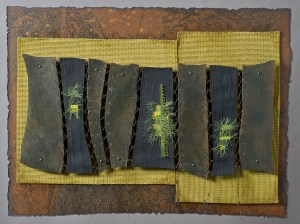
Trish works from her home studio. Her home is an open warehouse/loft in the Pearl District of Portland. (She also rents space in a metal shop from a welder for the messier parts of the process.) An idea board holds an important place above the ironing board in her studio. It is covered with images, words, type, skeletons, and so on. Those come down from the board when she is ready to work on them. She also keeps stacks of journals and sketchbooks. Her studio has no design wall, because the steel is too heavy to work with that way. Instead, she uses the floor to arrange the pieces, then stands on the stairs to look down at the work.
She began working with metal in 1999—in the early work, the metal was simply a frame. After taking an improvisational piecing class, she began cutting the metal into pieces and “stitching” it back together to make the frames. Next, she tried making tables, but the work was not spontaneous enough (people actually want tables that sit flat on the floor).
Some of the metal-framed work she did had openings where you could see past the quilted fiber pieces to the wall. She did enjoy working with the negative space, but realized she wasn’t choosing the composition because she did not control the color of the back wall.
As Trisha’s work developed, she began to work with found objects in addition to sheet metal. Her metal comes from a place on the river called The Steel Yard, which caters to artists. They have a selection of reclaimed construction steel and you can walk through and look at the piles. Much of it is rusted, and a lot of it is too heavy for her usesShe takes 10 x 4 ft sheets and cuts them down small enough that she can move them alone. She loves the rusty metal and sometimes has a tough time deciding which side to use. She uses the steel “as is” and simply seals it with polyurethane on both sides before bringing it into the fabric studio.
Trisha’s most recent work involves both piecing and bolting the frames, some of which are constructed in shadow box forms, 3” deep with the inside piece constructed as a quilt, and others are even more three-dimensional, constructed in a “house” form. Trish enjoys the engineering aspect of working with metal and making the pieces fit the way she wants, plus “who doesn’t want to play with fire?” she asks.
Her way of working with these two disparate materials is best explained by the opening text on her web site (http://www.trishahassler.com/):
“When I work in fiber, the experience is quiet, calm and clean. I do it in my home, dressed in yoga pants. The movements are intuitive, small and precise. This work requires patience, focus and good light. My love of this material runs deep in my bones.
When I work in steel, the experience is loud, hot and dirty. I do it at a metal shop, dressed in a leather apron. The movements are intuitive, large and fluid. This work requires strength, focus and safety equipment. My love of this material runs deep in my bones.
When I mix the two I enjoy discovering the place where they each hold their own and speak together.”

Kay Khan to teach Quilted Vessels at the Pacific Northwest Artschool

But first………

SDA member, Zia Gibson also wanted to let fellow SDA members know about her new collaboration with Sue Taves called Broken Mended Hearts.  You can visit the website to learn more by clicking HERE.

_______________________________________

Fall Offering at the Pacific Northwest Artschool

Kay Khan, – Quilted Vessels – Oct 22-26, 2012

Artists should often suspend judgment and indulge in play.  In this workshop, we’ll experiment with ways to create a heavily worked surface by stitching together layers of fabric, paper, and felt using machine and hand quilting, drawing, and collage.   We’ll find ways to embellish and build up the surface that will simultaneously add structure. The goal is to create a flexible but strong working material – thick with imagery, thick in layers – that we can then cut and stitch to create three dimensional forms.  We will make a paper pattern for the shape of the quilted sculpture, cut sections from the thick fabric material we create, bind the edges, and then build small vessels.

Quilted Vessels: Experiments in Building with Fabric and Collage

Instructor: Kay Khan
Date: 
October 22-26, 2012
Tuition:  $595/Deposit:  $100

To learn more about this class and to register, click HERE.

To see all the fiber classes being offered at the Pacific Northwest Artschool, click HERE.

Jane Dunnewold’s Advice to Artists –

(For those of you who were unable to attend the recent Surface Matters Symposium or were at a concurrent talk, we have asked fellow SDA members to write about about the various presentations. In this post, Lorraine Edmond writes about Jane Dunnewold’s presentation, “Strategies for Exploring Your Visual Language.” )

Jane Dunnewold is well known for her positive outlook and consistent support to artists at all stages of development.  Her presentation on “Strategies for Exploring Your Visual Language” began with these encouraging words: “There are as many ways to get started at

Jane Dunnewold at the Surface Matters Symposium. Photo by Jennifer Nerad.

this as there are people working.”  The range is broad– some people are color field people, while others are focused on very specific content and messages.  What is important is to make work that is recognizable as your own.  If you don’t know where to start, start with content, OR just begin somewhere, pick an object, work on design exercises, collect techniques.

Jane acknowledged the tendency many of us have to focus on “filling our toolbelts” with techniques, however, and emphasized that although there is a time for that, there is also a time to stop collecting techniques, to settle in on some that speak to us, and to put our own spin on them.  She described this evolution as “our responsibility as artists.”

For those of us who are still working at developing that visual language, she offered a multitude of possibilities for starting places.  Some are as simple as selecting a shape or image you like that can be interpreted in your own way (she showed several examples of circle imagery).  Another option is to pick a specific color or color palette to work from.  Jane emphasized that there are many ways of working that are “pre-cloth.”  Choose something to work with every day or until you’ve done a hundred.  Some people take a photograph a day for a year, while others carve a stamp or a printing block every day.

The “expanded square” or Notan is one good visual exercise to start from (do a search for “notan” and you will find an abundance of images as well as an inexpensive Dover book on the subject).  This exercise is a good way to learn to see positive and negative space, and it is worth doing every day for 30 days.  You can use the results of the successful ones to form a repeating pattern that can be applied to cloth in any number of ways.

Jane predicts that you will begin to recognize that your designs have some symbolic meaning, even if meaning is not your starting place.  She also believes it’s OK to work with public domain images and clip art when you don’t feel ready to make your own, but she stressed that “you have a right to make all your own” and that once you get started, you’ll actually love to make your own version of the usual symbols. Another recommendation (good advice that may be hard to follow) is not to jump around from one thing to another—it is OK to use the same image over and over.  The question Jane invites us to explore is “How many ways can you use those images authentically?”

Verbal, rather than visual, approaches can inspire work, too.  Try a free association exercise, starting with one word (her example was “boundaries”).  Set a clock and begin writing everything that comes to mind.  You may be surprised at how many visual images emerge from the list.

One way to build a series of work is to figure out your message, then develop the images. But not everyone likes to work that way—you can choose to be more or less structured.  You can also stay with some simple ideas and images.  “It is OK to go in the studio just to fool around, but it takes some planning to pull off what you see in your head.”:

After many of examples of the “how” aspect of working on visual language, Jane concluded with her perspective on the “why:”

“Life is too short to not love what you’re doing.  If you do love it, do it enough to be good at it.  You deserve to feel true passion for whatever it is you’re working on.”

Lorraine Edmond

After the Symposium …. Join a regional SDA group!

Here is a list of regional meeting and who to contact so that we can keep all this wonderful momentum going!

Thank you Christina Fairley Erickson for preparing this information.

(Click on the image below to enlarge it.  Because this is an image, the email addresses are not linked.   You will need to type them into an email.)

Surface Matters Symposium is just around the corner!

Hello All,

The Symposium Committee is putting last minute touches on what promises to be a spectacular symposium.  We are excited to have fiber artists coming from Canada, Oregon, California and all over Washington.  Our hope is that the connections we make this weekend will evolve into new joint ventures through out our region.  So come ready to make new friends, learn new things and perhaps take your art in new directions.

Our Venue is the Unitarian Church in the Wedgewood neighborhood of Seattle, just northeast of the University of Washington and minutes east of I-5.

6556 35th Ave NE
Seattle, WA 98115

Registration for Saturday’s Symposium opens at 8:30 am with opening remarks beginning promptly at 9 am.

If you have last minute questions, please don’t hesitate to email us at: info.surfacedesignwa@gmail.com.

See you there!