Every month Lorraine Edmond will give us a closer look at an SDA member, their studio and practice. This monthly post is a great opportunity to get to know our fellow SDA members a little better and to be inspired by our community.
1. Describe your current medium and how you came to it
I studied communications in college, but I had roommates who were in design fields. I was interested in their creativity, but  thought “I could not do that.” When my first child was young, I took up knitting, but I was impatient with it. I wanted to make too many things, but they took too long, and I ended up with unfinished projects. One Christmas, I think it was 2006, I decided to make felt-wrapped soaps as gifts. I got a book out of the library to find out how to do it. For the first time, I didn’t feel like “done that” when I was finished. Instead, I wanted to make everything in the book! I was immediately hooked, and I liked everything I made. I made slippers, bags, vases, anything I could think of. I began thinking about it all the time—“what would that be like in felt?”
I love that felting is what I call a “no-fail” medium, and without any significant barrier to entry, unlike other activities such as ceramics, or weaving, for example. It’s inexpensive to get into, it’s accessible, you can do it on a Saturday. Results are so immediate, especially compared to knitting.
I turned it into a full-time business by 2007. (I had to start selling things so I could keep buying materials!) I knew I didn’t want to go back to my previous work as a copyeditor when my youngest child started kindergarten, and I ended up being asked to teach felting classes almost before I knew what I was doing. I did workshops for friends at first, as our kids played on the floor around us while we felted. It was great experience though, and made me a better teacher and got me teaching much sooner that I would have otherwise. Now teaching is a big part of what I do. (Note: see Leah’s website for a schedule of current workshop offerings.)
2. What is your creative process like? (How do you begin? Do you draw to work out your ideas? Do you have a vision before you start or does it develop as you work?)
I have an idea or an inspiration when I begin. Sometimes I literally see things in dreams. Recently, I got a call from the Bellevue Arts Museum shop asking what I had that was new. (The answer was “nothing,” but that didn’t satisfy me.) I ended up taking a day off with a friend and just walking all around Capitol Hill for five hours. Afterward, I had a vision for a new product to try next—felted coasters based on topographic maps, which were not even consciously related to anything I saw or thought of that day.  After the idea comes, it’s a trial and error process. I start by making a prototype and go from there.
Sometimes I see a space for a commission and just immediately think “what needs to go there?” I may do a small sample for a big piece so that I can predict the shrinkage rate, for example, but in general, I don’t use sketches, plans, or samples. I do keep notes to refer back to in case I get an order for something similar. But even though most of my work is production work, rather than what I’d call “fine art,” I’m the first to say that no two pieces can ever be exactly the same—it’s just the nature of the medium.
3. What is your current workspace like?
Since September, I have been sharing a 700 square foot studio with another artist, Maude May. It’s called Spark Studio, and it is in 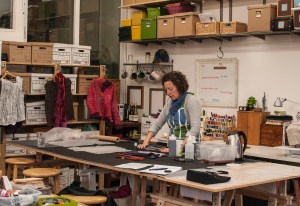 the same building as my previous studio, but on the first floor, and opens to the street (which has both pros and cons). There’s actually probably 500 square feet of working space after you subtract the bathroom and loft stairs. It has great windows and beautiful light.
4. If this isn’t your first studio, tell us about some of the other work spaces you’ve had—what worked, what didn’t and how your physical space affected your work.
My space is a big, big deal to me. I worked on my kitchen table at first and everything had to be put away by 3 PM when my kids came home from school. Then I moved to a windowless basement (with no sink) and worked there for three years. I felt very confined, and everything I made was small. I didn’t have the space to imagine bigger.
A friend who was visiting told me “this isn’t good enough—you deserve better. You’ll be more productive.” Other friends and family were of the opinion that it would be too stressful, that renting a studio would add too much financial pressure.
In 2010, I moved to my first studio outside my home. I had 250 square feet and high ceilings. It made a huge difference. I had water and light. I started working messier, using raw fleece. I could leave projects out. I had several large tables and could have quite a few students working at a time.
When I was working at home, there was no playing or experimental time. I felt I had to justify spending time on felting instead of cleaning house or grocery shopping. When I moved to a studio, I was so excited to get to work in the morning, I’d be heading out the door before my kids made it to the bus stop on their way to school.
Earlier this year, I wrote a long article for my brother’s blog that goes into more detail about this. It’s called “Becoming an Artist on a Mother’s Schedule.” (http://www.beamsandstruts.com/articles/item/926-felt).
5. Do you have a favorite piece of equipment or technique for keeping your studio organized?
The structure of monthly participation in the Ballard Art Walk helps—I have to clean up for that! Actually, I am pretty organized—more organized than neat. Everything has a place and I put things away, but I don’t dust a lot and don’t look under the couch! As for equipment, I do have some great hanging shoe organizers from Ikea that I use to store my patterns in labeled pockets. I used to keep really detailed notes as well, but I found I never went back to use them.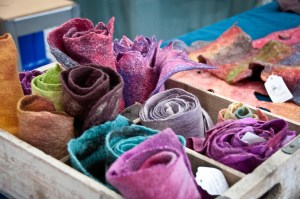
6. Do you have particular habits that you think support your art practice?
I come to the studio all the time. There is always something to work on. There’s always a backlog of ideas as well—those thoughts you have that “if I ever get the time, I want to try this.”
7. What is the best art tip you’ve ever received (or discovered)?
The best advice I ever got was hard to hear. An experienced felter looked at my work and said “you need to work on this longer—it isn’t quite done.” She thought the physical felting was not adequate. So working with a mentor who has more experience can be really important. You have to be able to take constructive criticism with humility. The best advice is to not become defensive or proprietary. It is also good to have the humility to take classes from others, or to work collaboratively with those who have more experience. Be open to critique, be open to having your work judged. Take the risk to do things that are different.
8. What inspires you to work and how do you keep motivated when things get tough in the studio?
I don’t have that struggle. I do mostly production work, not specifically surface design in the sense of embellishment beyond that. 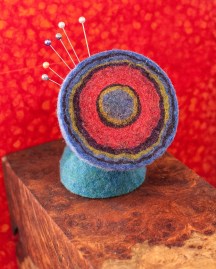 All my work has to be done as I go—it’s the nature of the work. Pieces may be done from start to finish in 4 or 5 hours, so there’s no time to get “stuck.” I envision the process from beginning to end. Deadlines are inspiring, though! (As is remembering that the rent is due every month.) I am trying to do this as a business—with the holidays approaching, I know when I have to deliver things and how long they take to make, so that’s always on my mind.
For more information or to see Leah’s work:
You can see beautiful photographs of Leah’s work on her web site. Both finished work and kits are available through her Etsy shop:
http://www.spiderfelt.com/ and http://www.etsy.com/shop/kneek.
You can see Leah’s work in person at the Bellevue Arts Museum shop, Venue in Ballard, the Columbia City Gallery, Made in Washington stores and Tasty on Greenwood Ave. Or check out Spark Studio during the Ballard Art Walk. The address is BallardWorks, 2856 NW Market St, Seattle. Leah and her studio-mate Maude May are also having a Studio Sale December 8 and 9.
To keep up with Leah’s felting activities, you can also “like” her Spiderfelt Facebook page, where she posts frequently. https://www.facebook.com/pages/SpiderFelt/41296859673


 Seattle (206) 784-7272.
  sculpture artist who will talk about her work from 2-3pm , including a seven foot paper sculpture on display at the shop.
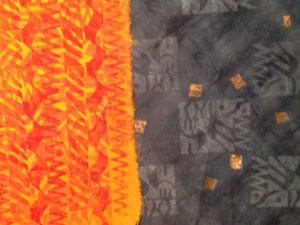 The Evening SDA meeting is going to explore symbology and make rubber stamps.
 Surface Design Association–Washington
You must be logged in to post a comment.